At Academy of Brain, science creates the foundation of our approach to soft skills learning. Research-based insights inform the design of our learning model and learning content, supporting impact within organizational strategies and operational realities.
Soft skills are learnable and observable core human capabilities that play a central role in the ongoing, AI-driven transformation of human value creation in work organizations. They do so due to their foundational role in shaping how people perceive, reflect, interact, and act within complex social and organizational environments – both individually and collectively. As such, soft skills are not peripheral attributes or interpersonal add-ons, but foundational capabilities through which individuals and organizations navigate complexity, make sense of change, and translate strategy into everyday action.
Although the importance of soft skills is widely recognized, translating this recognition into systematic development has remained challenging. This is largely because soft skills constitute complex human capabilities indicative of both individual and collective psychological development. They depend on individual and collective growth and thus develop only through reflective, relational, and context-dependent processes that differ from the straight-forward mechanisms through which more technical or hard skills are typically learned.
Understanding and developing these capabilities therefore requires grounding in research, combined with professional expertise and contextual insight into the constraints and opportunities of human resource development practices in everyday organizational realities.
Our science and research -based approach rests on four complementary foundations:
Academy of Brain’s work is grounded in established research traditions in cognitive neuroscience, psychology, organizational science, and labor economics research. This research defines what we know about human perception, learning, self-awareness, interaction, leadership, as well as the ongoing adaptation and transformation of work organizations as we step into a new era of human value creation.
Dr. Ville Ojanen, co-founder of Academy of Brain, holds a Ph.D. in cognitive neuroscience and has over two decades of professional experience as a practising organizational psychologist. His ongoing engagement with current research ensures that the organization’s strategies, methodologies, and content remain aligned with contemporary scientific understanding.
Our scientific foundations are built on:
Scientific knowledge gains value only when applied effectively. Soft skills development unfolds within real organizations shaped by institutional structures, professional norms, power relations, and ethical considerations.
Academy of Brain adheres to the professional ethics and practices of organizational psychology, ensuring that all services and content meet high professional and ethical standards as well as best practices.
Professional integrity is supported through:
Applied learning science addresses how research-based knowledge is translated into a soft skills learning model that supports meaningful, effective and sustained capability development.
Academy of Brain applies findings from work and organizational psychology, adult education research, and learning sciences to implement a specific soft skills learning model that supports:
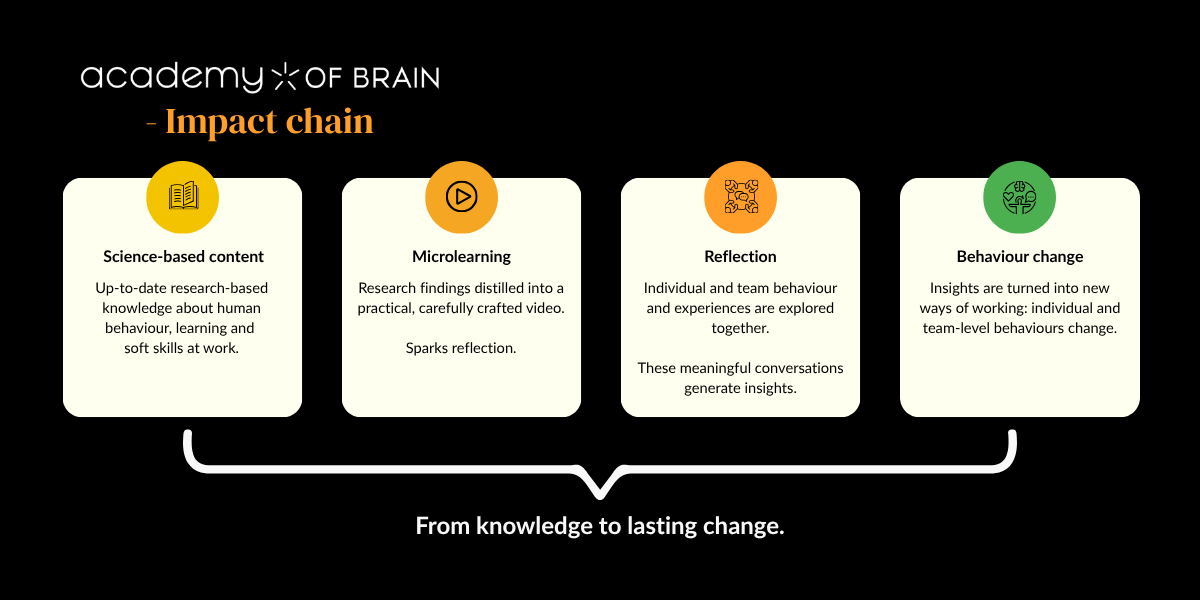
These principles set the foundation for how applied learning science is translated into impactful learning experiences that drive results in the form of individual and collective behavioral change.
Our soft skills micro-learning content library is informed by foundational research in perceptual and cognitive psychology, which explains how humans attend to, interpret, and make sense of information in dynamic environments. These perceptual and cognitive processes determine whether learning content is noticed, understood, and retained in the first place.
This perspective is particularly relevant in video-based and digital learning, where attention, cognitive load, and perceptual clarity directly shape learning outcomes.
Key principles guiding our content design include:
By incorporating these principles into learning content and video design, Academy of Brain aims to reduce unnecessary cognitive load and create conditions under which reflective, dialogical, and social learning processes can take place.
Beyond the form of our content, the substance of our learning content is equally research-informed. The themes and perspectives presented in our videos are grounded in relevant research literature as well as established professional practice in psychology, leadership, and organizational development.
Each learning module and video includes curated references that make its theoretical and empirical foundations explicit, supporting transparency and further exploration.
Importantly, micro-learning content is not treated as an end in itself, but as an entry point into broader learning processes that include reflection, peer dialogue, and application in everyday work.

Scientific foundations establish what is known, professional integrity governs how that knowledge is used and applied learning science drives impactful learning behaviors.
Together, these principles allow Academy of Brain to design soft skills learning that is credible and effective, supporting individual growth and organizational development in complex, real-world contexts.
Academy of Brain muuttaa mielesi käyttäytymistieteelliseen tutkimukseen perustuvien valmennusten avulla. Verkkovalmennukset kehittävät tärkeimpiä työelämätaitoja, hyvinvointia ja itsensä johtamista. Opit palautumaan ja keskittymään sekä parannat vuorovaikutustaitoja, johtamista ja tapaa toimia määrätietoisesti paineen alla. Sisällöt keskittyvät psykologisten taitojen (soft skills) kehittämiseen. Tässä muutamia esimerkkejä sisällöistämme, jotka ovat kaikki palvelussa käytössäsi:
Ville Ojanen is a psychologist with a doctorate in cognitive neuroscience. His passion is understanding and influencing the human behavior. Ville combines an exceptionally broad and in-depth understanding of behavioral and neurosciences with practical experience in developing individuals, teams and communities.
He has worked as a clinical neuropsychologist, as an HR professional in Nokia and for fifteen years as an organizational psychologist, coach and keynote speaker. Ville is a serial entrepreneur and the co-founder of Academy of Brain Ltd. He has served in the behavioral science advisor team of the Finnish Prime minister´s office since 2020, currently as a steering group member.
“Change the mind, change the world”
Ashley, G. C., Reiter-Palmon, R., & Mumford, M. D. (2020). Self-awareness and leadership: Relationships with leader self-efficacy, follower satisfaction, and team performance. Frontiers in Psychology, 11, 1480.
Burke, W. W. (2017). Organization change: Theory and practice (5th ed.). SAGE Publications.
Cimatti, B. (2016). Definition, development, assessment of soft skills and their role for the quality of organizations and enterprises. International Journal for Quality Research, 10(1), 97–130. https://doi.org/10.18421/IJQR10.01-05
Deming, D. J. (2017). The growing importance of social skills in the labor market. The Quarterly Journal of Economics, 132(4), 1593–1640.
Hosseinioun, M., Neffke, F., Zhang, L., et al. (2025). Skill dependencies uncover nested human capital. Nature Human Behaviour, 9, 673–687.
Leblanc, P.-M., Harvey, J.-F., & Rousseau, V. (2024). A meta-analysis of team reflexivity: Antecedents, outcomes, and boundary conditions. Human Resource Management Review, 34.
Mostrady, A., Sanchez-Lopez, E., & Gonzalez-Sanchez, A. (2024). Microlearning and its effectiveness in modern education: A mini review. Acta Pedagogia Asiana, 4, 33–42.
Schippers, M. C., West, M. A., & Dawson, J. F. (2015). Team reflexivity and innovation: The moderating role of team context. Journal of Management, 41(3), 769–788.
Uhl-Bien, M. (2017). Complexity leadership: Enabling people and organizations for adaptability. Organizational Dynamics, 46(1), 9–20.
Wang, Z., Ren, S., Chadee, D., Liu, M., & Cai, S. (2021). Team reflexivity and employee innovative behavior: The mediating role of knowledge sharing and moderating role of leadership. Journal of Knowledge Management, 25(6), 1619–1639.
World Economic Forum. (2025). The future of jobs report 2025. https://www.weforum.org/reports/the-future-of-jobs-report-2025
AI is reshaping work and skill requirements faster than ever. Our new white paper, Soft Skills as Strategic Competencies in the AI Era, shows why sustainable results come from soft skills alongside technology.
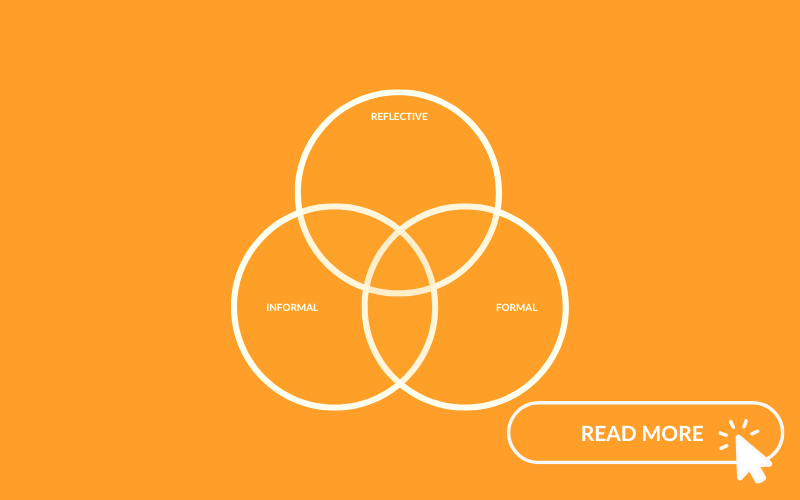
The publication combines research insights and real-world observations, and introduces the Academy of Brain’s Reflective Cycle Framework, which supports the systematic and scalable development of soft skills within organizational learning and development.